Introduction

Art critic Clement Greenberg defended the idea of medium-specific in relation to the characteristics of the format in which the artist works. Greenberg postulates that abstract painting is the best possible approach to medium-specific, since it “bends to the flatness, the opacity, of the painted surface” (quoted in Bee Bernstein). The artist is thus freed from the representation of reality in order to focus on the specificity of the medium. As a result of this conception, many artists have explored the idea of working with the characteristic elements of the medium they were working with.

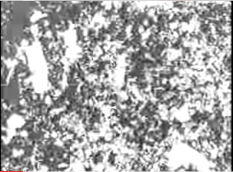
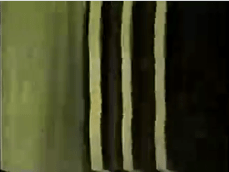
Early cinema includes figures such as Alice Guy or George Melies, whose experimentation with celluloid through overprints or double exposures already foreshadowed the wide range of manipulation possibilities that the medium itself would offer. In avant-garde cinema from the 1920s onwards -if we follow the distinction between avant-garde and experimental cinema proposed by Peter Bürger- we find some artists who also work with the properties of celluloid. Man Ray, for example, works with double exposures in Emak-Bakia (1926). In Le Retour à la Raison (1923) he places elements directly on the frame, without the camera, . Similarly, Len Lye works without a camera and applies colors and dyes directly to celluloid in his film A Colour Box (1932).

Frame of Le Retour à la Raison (1923)

Frame of A Colour Box (1932)

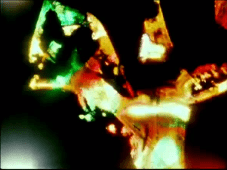
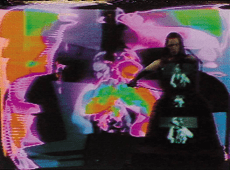
After the war, experimental cinema and video art -as a consequence of the appearance of video- continue the path of manipulation of the material support. Stan Brakhage, one of the great experimental filmmakers of the late 20th century, created The Dark Tower (1999), a film consisting of a succession of celluloid stills that have been torn and scratched. From the world of video art, Nam June Paik intervenes videotapes with synthesizers, modifying, among other aspects, video recordings in real time.

Frame of The dark Tower (1999)

Frame of Global Groove (1973) de Nam June Paik

However, the advent of the digital era poses new challenges in manipulating the intrinsic properties of media. Cinema is the art that has been most affected by the new digital technologies of image and sound. Jorge La Ferla states that “today, the digital image almost definitively replaces celluloid, from image capture to projection” (La Ferla, 2009). Many filmmakers have stated that they no longer want to use celluloid in their films, such as George Lucas or James Cameron. Digital video editing software has opened up unimaginable possibilities, making it possible to integrate into the digital image elements that seem to be taken from other planets. Therefore, Manovich says that part of the digital specificity is the software (Manovich, 2013).

But, if we reduce digital cinema to its most basic form, we realize that it is made up of a long list of lines of code. These are are the ones that give life to the moving image we watch on a computer, a digital projector, a cell phone or any other digital device. A very reasonable doubt then arises: in what ways can we modify and operate the most fundamental characteristics of the digital file, just as filmmakers and artists did with celluloid and magnetic video tapes?


Error in the digital archive

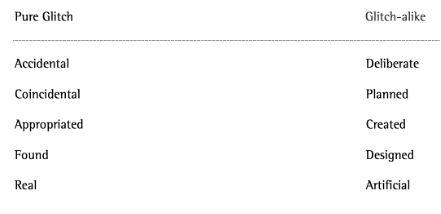
Mistakes are something we generally try to avoid. When working with digital media, it is relatively common for corruptions to occur in the files that result in a “spoiled” image. However, there is an artistic current that has been able to take advantage of these “errors” or glitches and use them in the creation of works. Iman Morandi was one of the first to theorize about the glitch. He established the existence of two types: the random (“pure-glitch”) and the provoked (“glitch-alike”) (Morandi, 2004). Within the latter, we find two possible manipulations: databending and datamoshing (Gomis, 2017). The former consists of altering the data that make up the digital file, while the latter is based on the use of different compression methods applied to the files to generate glitch.

Morandi not only limits his proposal to the types of glitch according to intentionality, but identifies a series of characteristics for each of them and linked to different artistic procedures:

Diagram from Iman Morandi in Glitch Aesthetics.

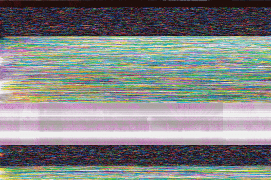
Solimán López is an artist who in 2016 created his work More than 404. In it, he offered the public the possibility of downloading 1212 of his files that had been corrupted by a failure in one of his hard drives. In this case, the artist has decided to take advantage of that “pure-glitch”, in Morandi’s terms, to turn it into a conceptual art piece that allows direct interaction with the public -each one can download the files and open them with different programs to see the effects of the corruption.

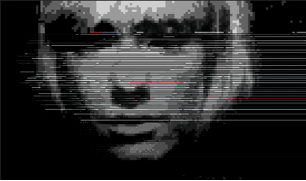
Aligned with the other procedure, we could situate the work of Rosa Menkman, who generates glitch on a series of photographic portraits. This visual artist has produced this effect by modifying the code of the photographic files. Her work can ve seen in Anonymous by mistake: glitch portraits, a virtual exhibition with other artists who work with glitch.

Imagen de uno de los archivos de Solimán López
Retrato de Rosa Menkman

The “glitch-alike” may be one of the closest ways to modifying the parameters of the digital file and, consequently, digital cinema. In other words, altering the code of a digital video file is as close as you can get to Brakhage ripped celluloid.

GLITCH MARKER

Starting from the historical and theoretical foundations outlined above, my goal was to create a piece in which I could manipulate the basis of any digital video file: the code. In an attempt to recreate Len Lye’s or Brakhage’s exercises related to celluloid, I created a five-second black video generated by a video editing program, an equivalent to virgin film in the digital era, a sort of black canvas, and then subjected it to various alterations in the code.

Soon after, I realized the disadvantage of my purely formalistic approach, since this black video did not have enough information in its code to generate significant alterations that could be translated visually.

For this reason, I began to consider the possibility of using appropriation to satisfy my need to find a juicy code. As the idea of starting from black still seemed to me the most attractive to emphasize that code is present in any digital file, I decided to resort to Chris Marker’s interesting reflection on black at the beginning of Sans Soleil.

The work of appropriation seemed doubly relevant to me, since on several occasions Marker introduces in Sans Soleil video images supposedly modified by his friend “Hayao Yamaneko” thanks to a synthesizer, in much the same way as Nam June Paik. Although his intention was to question historical images and my piece focuses on the formalist manipulation of the medium itself, it is interesting to work with a material that reflects on the transformation of images. Perhaps Chris Marker would never have done an exercise like this, since his formal work was always based on an exercise in thought.

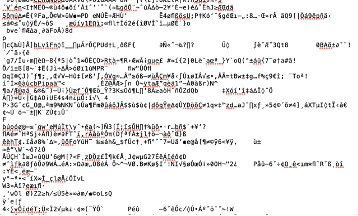
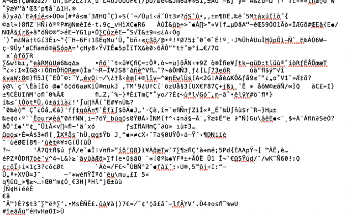
I downloaded a digital copy of the film and cut out the beginning part. I then duplicated that file several times and began to corrupt the files gradually using the computer’s text editor to modify the code. In the first few files, I modified single characters of the code to achieve a reduced effect. Because I wanted a progression from less to more glitch, in the later files I altered series of characters – 5000 characters at a time or so. There were some files where I so mangled the code that they were unrecognizable by the computer, so I had to repeat them.

Screenshots of code of the fragment of the digital film.

The final result is a succession of the same initial fragment of Sans Soleil, whose repeated files have been gradually corrupted. The interesting thing about glitch art is the randomness of the result. Changing one character or another makes a big difference in the final appearance of the piece. In short, it is a matter of randomly modifying some of the thousands of characters that make up that file. To show this in the piece, I have introduced on the screen a series of lines of code from the video with some modifications marked in red, which become more numerous as the piece progresses. The last file is so corrupted that only a black screen can be seen, sometimes crossed by brief flashes of glitch. The manipulation of the information in the file is such that only the black remains, or as the voice-over in Marker’s fragment says, “at least they will be able to see the black”.

We can conclude that the specificity raised by Greenberg, in an approximate application to the digital, may be these lines of code that make up digital video files. With this work, my goal was to reflect on the digital video medium itself, something that I use as a transparent medium in such an everyday way that I do not perceive its specificity.

Bibliography

Bee Berstein, E. medium specificity. The Chicago School of Media Theory. Recuperado el 28 de noviembre de 2020 de: https://lucian.uchicago.edu/blogs/mediatheory/keywords/medium-specificity/

Bürger, P. (2000). Teoría de la vanguardia. Barcelona: Península.

Gomis, J. A. (2017). Videoarte y apropiacionismo. Una investigación del Error y el Glitch-Art.

(TFG, Facultad de Bellas Artes San Carlos. Universitat Politécnica de Valencia) Recuperado de: https://riunet.upv.es/bitstream/handle/10251/94023/GOMIS%20-%20VIDEOARTE%20%20Y%20APROPIACIONISMO.%20UNA%20INVESTIGACION%20SOBRE%20EL%20ERROR%20Y%20EL%20GLICH-ART..pdf?sequence=1

Manovitch, L. (2013). El software toma el mando. Barcelona: UOCpress.

Morandi, I. (2004). Glitch Aesthetics. School of Design Technology. The University of Huddersfield. Recuperado de: http://www.organised.info/wp-content/uploads/2016/08/Moradi-Iman-2004-Glitch-Aesthetics.pdf

La Ferla, J. (2009). Cine (y) digital. Buenos Aires: Manantial.

Consulted webs – pieces and works

García, O. (2016). Solimán López y el arte de la corrupción digital. Plataforma de Arte Contemporáneo (PAC). Recuperado el 28 de noviembre de 2020 de: https://www.plataformadeartecontemporaneo.com/pac/soliman-lopez-y-el-arte-de-la-corrupcion-digital/

Ramis, M. Len Lye. IDIS. Recuperado el 1 de diciembre de 2020 de: https://proyectoidis.org/len-lye/

S.A. (2001). Los mundos de Nam June Paik. Guggenheim Bilbao. Recuperado el 1 de diciembre de 2020 de: https://www.guggenheim-bilbao.eus/exposiciones/los-mundos-de-nam-june-paik

S.A. (2009). El arte de ser imperfecto. La liga. Recuperado el 28 de noviembre de 2020 de: http://www.laligad.com/tag/iman-morandi/

Trilnick, C. Nam June Paik. IDIS. Recuperado el 1 de diciembre de 2020 de: https://proyectoidis.org/nam-june-paik/

I am grateful to Alejandra Crescentino, researcher at the Universidad Autónoma de Madrid, for the information on the works of Iman Morandi and Solimán López and on the IDIS Project (Image and Sound Design Research) of the Universidad de Buenos Aires.